
How talk does things in schools
Talk in schools isn't just the setting — it's the work. Build shared meaning and real commitment in every conversation.

Walk into any school and almost everything you observe is downstream of talk. Teachers build curriculum in planning meetings. Principals shape culture through the phrases they repeat. Students learn to think by speaking before they write. We tend to treat conversation as the setting in which educational work happens. It might be more accurate to say it is the work.

And yet most educators have never been given tools for thinking precisely about what conversation actually does. The default assumption is that talk transmits ideas — that meaning travels from one mind to another like a document passed across a table. Research in psycholinguistics, philosophy, and organizational theory has been quietly complicating that picture for decades. Meaning is not transferred. It is built, jointly, in the live act of speaking and responding.
This post draws on three bodies of work to trace that argument and bring it to ground. The first is an empirical study of how people coordinate shared meaning in real-time dialogue. The second is a philosophical framework for understanding talk as action and commitment, not mere expression. The third pulls both threads into the specific realities of classrooms, planning meetings, and educational leadership conversations that either move things forward or endlessly circle. The goal is not to make dialogue more complicated. It is to make it more visible — and therefore more useful.

Shared meaning is built
In 1987, Simon Garrod and Anthony Anderson published a study that deserves far more attention in education than it has received. They seated pairs of participants in separate rooms and gave them a cooperative computer maze game to play. Because neither player could see the other’s full screen, they had to talk constantly — describing their positions, guiding each other, negotiating around obstacles. They had no pre-agreed vocabulary for any of it. The only resource available was live conversation.
From 56 dialogues and nearly 1,400 location descriptions, a clear pattern emerged. Partners did not arrive with a shared language for space — they built one. Over time, pairs converged on a single description scheme, whether path-based (”go two along, one up”), coordinate-based (”I’m at C4”), or figural (”I’m in the rectangle at the bottom right”). This convergence happened not through explicit negotiation but through a simpler mechanism the researchers called output/input co-ordination: speakers tended to formulate their own descriptions using the same interpretive logic they had used to understand their partner’s most recent utterance. As the dialogue proceeded, this iterative alignment produced something neither person had arrived with — a shared way of seeing the domain.

The implications for anyone who sits in a classroom or a faculty meeting are significant. When a colleague echoes your phrasing, picks up your vocabulary, or signals understanding with a nod or a quiet “right,” that is not small talk. It is the active work of building shared meaning. And when those signals are absent — when partners are operating from different conceptual frameworks without realizing it — coordination fails silently. The word “rigor” means something different to the department chair than to the new teacher across the table. “Student-centered” carries one mental model for one person and something else entirely for another. The conversation feels productive. The shared ground isn’t actually there.
Talk is action
Fernando Flores, drawing on speech act theory and his own experience redesigning how organizations communicate, built his framework on a simple but consequential claim: language doesn’t merely describe the world — it acts in it. When a principal announces that literacy is a school-wide priority, that statement isn’t reporting a fact. It is making a move in a social game, one that opens futures, creates obligations, and positions everyone present in relation to one another. Flores argued that most of what we call organizational life is actually constructed from moves like this — not information flows, but acts of speech.

His practical framework, conversations for action, maps the deep structure of productive exchange. The cycle runs as follows: a request is made; the listener responds by committing, declining, or counter-proposing; the agreed action is carried out; and the loop closes with a declaration that the matter is complete. Most organizational breakdowns, Flores argued, are not failures of effort or intelligence. They are failures at specific joints in this cycle — requests that were never heard as requests, commitments offered socially but without real sincerity, completions that were never declared, leaving both parties in uncertain suspension about whether anything was actually resolved.
For teachers and school leaders, this reframe is uncomfortable in the best way. A department meeting where everyone shares ideas but no one makes a clear request is not just an inefficient meeting — it is a meeting where talk, for all its apparent activity, did nothing. No action was generated. No commitment was taken. This is close to the default condition of a great deal of educational discourse. The Flores framework doesn’t just diagnose that problem. It names the specific moves that are missing and points toward what a more action-generative conversation would actually look like.
These ideas together in schools
The two frameworks above converge on a shared insight that carries specific force in educational settings. Garrod and Anderson show us that shared meaning requires active coordination — it is not a given at the start of a conversation, but an achievement that accumulates through iterative exchange. Flores shows us that conversation is where commitment is formed or left unformed, where action begins or quietly stalls. Together, they suggest that the quality of talk in schools is not incidental to the quality of what schools do. It is constitutive of it.

This becomes especially visible when you look at the lived reality of teacher collaborative discourse and instructional leadership. Principals and coaches move through days that are almost entirely composed of talk — walkthroughs, feedback conferences, planning sessions, hallway exchanges. Each of those conversations is either building shared ground or eroding it; either generating commitment or performing it. The research on teacher professional discourse makes clear that teams can meet regularly and still diverge in their mental models of what good instruction looks like, because the coordination work — the echoing, the probing, the cycling back to request and commitment — is rarely made explicit or attended to.
What this body of work ultimately argues is that talk in schools needs to be understood as a technical practice (a science), not just a social one. The teacher who invites students to repeat, rephrase, and respond to one another’s ideas is not simply being participatory — she is engineering the conditions for shared meaning to form. The instructional leader who closes a meeting with a clear articulation of who committed to what is not being bureaucratic — she is completing a conversational cycle that would otherwise leave action floating. These are learnable skills. They are also the skills that most professional development never touches.
Implications for practice
The most direct implication of Garrod and Anderson’s work is that you cannot assume a shared framework simply because a conversation has occurred. Before any important meeting or discussion — whether with students, colleagues, or leadership teams — it is worth slowing down long enough to surface the mental models already in the room. What does this team actually mean by “rigor”? What does “student voice” look like in practice to each of us? The coordination work has to happen before the work can happen.
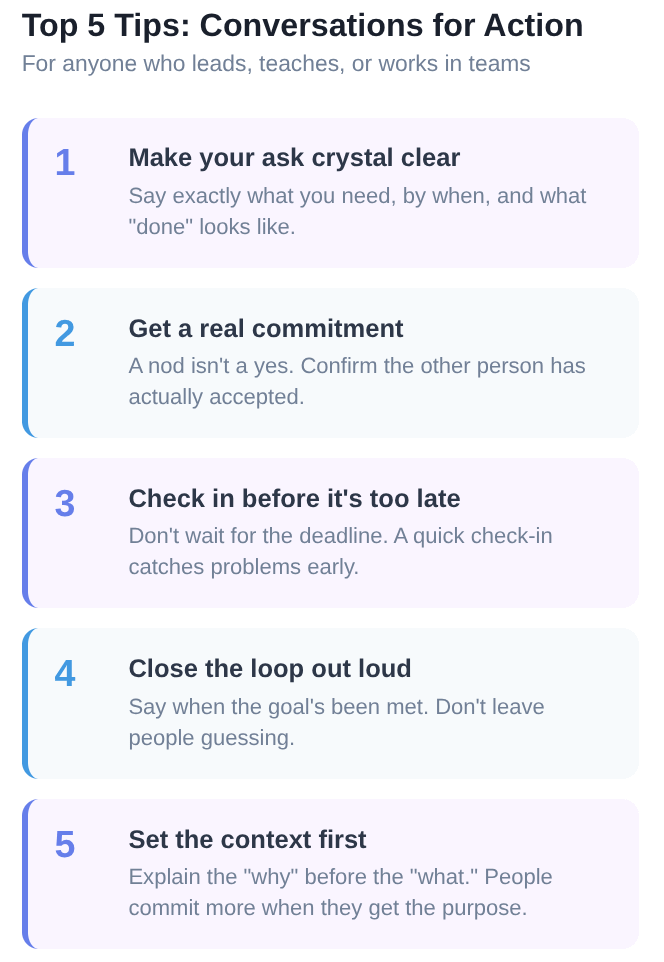
From Flores, the practical takeaway is structural: every productive conversation eventually needs to move through a full cycle — from request to commitment to completion to declaration. Leaders and teachers can begin by auditing their own meetings and conferences for where that cycle breaks down. Are requests being made clearly and heard as requests? Are commitments being offered sincerely, or performed? Is completion being declared, or does every topic just drift into the next agenda item? Learning to name these breakdowns is already a significant step toward interrupting them.
Taken together, these frameworks point toward a unified discipline that might be called conversational craft — a deliberate, reflective attention to how talk works, not just what it is about. For educators who already believe in the power of dialogue, the invitation here is to go deeper. It is not enough to create space for talk. The question is whether the talk being done is the kind that builds shared ground, generates real commitment, and moves people toward action. That question, asked seriously and regularly, changes what it means to teach, to lead, and to collaborate.
References
Garrod, S., & Anderson, A. (1987). Saying what you mean in dialogue: A study in conceptual and semantic co-ordination. Cognition, 27(2), 181–218.
Denning, P. J. (2013). The other side of language. Communications of the ACM, 56(9), 35–37. https://doi.org/10.1145/2500132
Flores, F. (2013). Conversations for action and collected essays (M. Flores Letelier, Ed.). http://conversationsforaction.com