

After seven years in educational leadership and reform work, I've returned to the high school English classroom. Sitting in team meetings, collaborating with colleagues, and engaging in those familiar conversations about teaching, I'm struck by a persistent frustration: we can't seem to talk clearly about what actually happens in our classrooms.

Despite hours in professional learning communities, department meetings, and collaborative planning sessions, I find myself surrounded by what feels like performance rather than genuine exchange. We dance around specifics, speak in institutional rhetoric, and somehow never quite get to the teaching and learning. What questions are we actually asking students? What examples are we using? What does student work really look like? These concrete details remain frustratingly elusive.
Recent research on teacher collaborative discourse helps explain why. Three groundbreaking studies reveal the hidden social dynamics that make authentic professional conversation so difficult—and point toward what we might do about it.
Talk about teaching divorced from teaching
Educational researchers Adam Lefstein, Dana Vedder-Weiss, and Aliza Segal argue that we've been looking for teacher learning in all the wrong places. While we pour resources into formal professional development workshops led by outside experts, the real learning happens (or fails to happen) in the informal conversations embedded in teachers' daily work.
But here's the catch: most teacher discourse avoids the very thing that could make it productive—genuine problems of practice. Instead, as Lefstein and colleagues found, teachers typically focus on "logistics and planning" rather than substantive instructional challenges. When problems do surface, they're often met with a "flood of advice" or "tips and tricks" that shut down deeper inquiry.
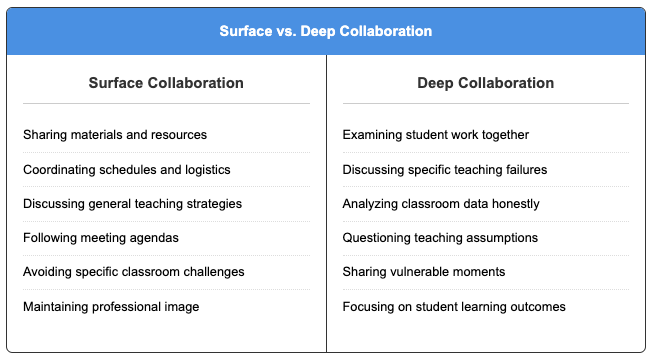
This matches my experience perfectly. How often do we hear phrases like "What worked for me was..." or "You should try..." without ever digging into why something worked, under what conditions, or how it might transfer to different contexts? We're sharing solutions to problems we haven't fully examined, using representations of practice that are "necessarily partial" and limited by individual perspective.
The research reveals that this isn't just inefficient—it's a fundamental mismatch between how we talk about teaching and the complex, uncertain nature of teaching itself. When our professional discourse remains at the surface level, we miss opportunities to develop what researchers call "adaptive expertise": the ability to notice critical moments, interpret what's happening, and respond flexibly to novel situations.
Why we can't handle the truth
One of the most eye-opening findings comes from research on "face-work"—the often unconscious strategies we use to protect our professional image during collaborative discussions. When Dana Vedder-Weiss and colleagues analyzed video-based teacher discussions, they discovered that teachers spent a staggering 60% of their discussion time managing face concerns rather than focusing on instruction.
This explains so much about why our collaborative conversations feel unsatisfying. Every time we share student work, discuss a lesson that didn't go well, or question a colleague's approach, we're potentially threatening someone's professional face. The natural human response is to engage in protective strategies: offering excessive praise before any critique, avoiding specific problems, or shifting discussions away from actual practice.
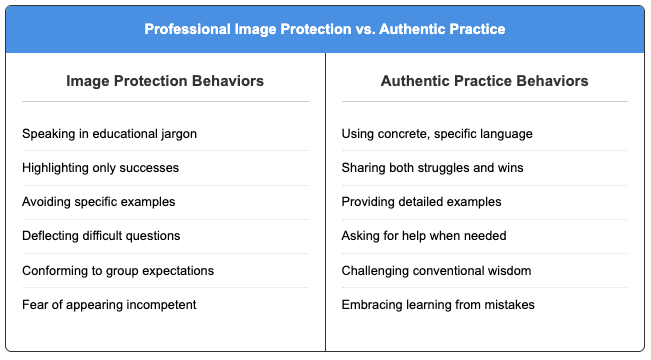
I see this constantly in my current school context. When reviewing student data or discussing curriculum implementation, there's an unspoken agreement to maintain what researchers call "polite norms of support and solidarity." We've all learned to speak in diplomatic code: "I wonder if..." instead of "This isn't working," or "What's been your experience with..." instead of directly addressing obvious problems.
The researchers identified numerous face-work strategies teachers use, from preemptively justifying their practice to dominating conversations to prevent critique. While these strategies serve the important social function of maintaining collegial relationships, they can also "constrain critical discussion and impede learning."
The assessment trap
Perhaps nowhere is this dynamic clearer than in discussions about assessment—which research shows are particularly volatile. Rotem Trachtenberg-Maslaton and colleagues found that while disagreements about assessment lasted much longer than other professional disagreements and involved more consequential decision-making, they were also significantly more disputative and face-threatening.
Assessment conversations hit differently because they're inherently public and tied to accountability. When we discuss grading practices, evaluation methods, or student performance data, we're not just sharing professional opinions—we're exposing our effectiveness as teachers. The research revealed that 78% of assessment disagreements involved immediately binding practical decisions, making them high-stakes in ways that theoretical discussions about pedagogy are not.

I've witnessed this firsthand in data meetings where teams review student performance. Despite protocols designed to promote collaborative inquiry, these sessions often devolve into defensive explanations or blame attribution. Teachers attribute student failure to factors beyond their control—student motivation, family background, previous teachers—rather than examining instructional practices that might be adjusted.
The researchers found that teachers blamed students for failure three times more often than they blamed teaching practices. While some of this attribution may be accurate, the pattern suggests a systematic avoidance of the kind of professional vulnerability that real improvement requires.
What's particularly insidious is how institutional rhetoric can exacerbate these dynamics. When schools emphasize "data-driven instruction" or "continuous improvement" without acknowledging the face-threatening nature of these conversations, teachers learn to perform compliance rather than engage authentically with their practice.
What productive discourse looks like
Despite these challenges, the research also reveals what's possible when teachers manage to navigate social dynamics productively. Truly collaborative professional discourse has six key characteristics:
1. Focus on specific problems of practice rather than abstract theories or alleged "best practices." This means bringing actual student work, specific lesson challenges, or concrete classroom dilemmas to the conversation.
2. Engage in pedagogical reasoning that uses evidence and explanation to connect teaching decisions to student learning. Instead of just sharing what we did, we explore why we did it and what happened as a result.
3. Use rich representations of practice like video clips, student work samples, or detailed lesson artifacts that make the invisible work of teaching visible to colleagues.
4. Include multiple voices and perspectives rather than seeking false consensus or avoiding disagreement. This requires what researchers call "critical colleagueship"—the ability to challenge ideas while maintaining supportive relationships.
5. Maintain inquiry-oriented, asset-based approaches to students and problems rather than deficit-focused explanations that position challenges as insurmountable.
6. Balance support and critique by fostering trust while still engaging in the kind of questioning that leads to growth.
The research shows that when teachers successfully navigate these elements, their conversations can develop the adaptive expertise that teaching demands. They become better at noticing critical moments, interpreting student responses, expanding their instructional repertoire, and making sound professional judgments.
Implications for practice
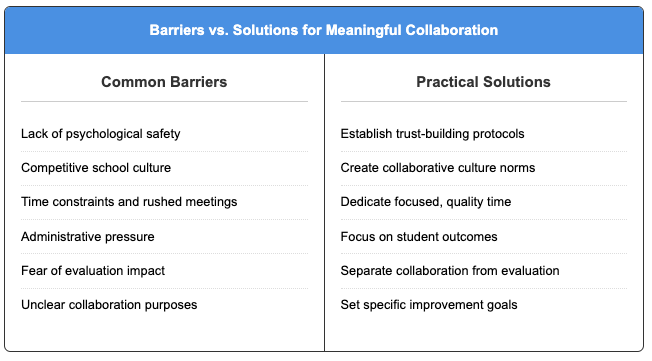
So what does this mean for those of us trying to create more authentic professional learning in our schools? The research suggests several practical approaches:
Acknowledge the social reality. Stop pretending that face concerns don't exist in professional conversations. Building awareness of these dynamics is the first step toward managing them productively. Teams might benefit from explicit discussion about the vulnerability inherent in sharing practice and developing norms that support both honesty and collegiality.
Start with problems, not solutions. Instead of beginning meetings with sharing "what's working," create structured opportunities for teachers to bring genuine instructional challenges. Develop protocols that help teams investigate problems collaboratively rather than immediately jumping to advice-giving.
Make practice visible through artifacts. Move beyond verbal descriptions to concrete representations of teaching and learning. Bring student work samples, lesson recordings, or detailed curriculum materials that allow for specific, evidence-based discussion.
Reframe assessment conversations. Recognize that discussions about grading, evaluation, and student performance are inherently more volatile. Build extra supports for these conversations, including clear purposes, structured protocols, and explicit attention to maintaining psychological safety.
Train facilitators in social dynamics. Whether department heads, instructional coaches, or teacher leaders, those facilitating collaborative conversations need skills beyond content knowledge. They need to understand face-work, recognize when it's helping or hindering learning, and know how to redirect conversations toward productive inquiry.
Question institutional rhetoric. Be skeptical of mandated collaboration that doesn't account for the social and emotional realities of professional learning. Push back against "data meetings" or "PLC protocols" that emphasize compliance over authentic inquiry.
The goal isn't to eliminate face concerns—they're a natural and necessary part of human interaction. Instead, we need to create conditions where teachers can engage with problems of practice without feeling that their professional competence is under constant judgment.
As I continue navigating the complex social terrain of teacher collaboration, I'm reminded that real professional learning requires both intellectual honesty and emotional safety. The research shows us that this balance is possible, but it requires intention, skill, and a willingness to move beyond the performance of collaboration toward its authentic practice.
References
Lefstein, A., Vedder-Weiss, D., & Segal, A. (2020). Relocating research on teacher learning: Toward pedagogically productive talk. Educational Researcher, 49(5), 360-368.
Trachtenberg-Maslaton, R., Vedder-Weiss, D., Lefstein, A., & Israeli, M. (2025). 'I don't assess children this way' – how do disagreements about assessment support (or limit) teacher on-the-job learning? European Journal of Teacher Education, 48(3), 620-643.
Vedder-Weiss, D., Segal, A., & Lefstein, A. (2019). Teacher face-work in discussions of video-recorded classroom practice: Constraining or catalyzing opportunities to learn? Journal of Teacher Education, 70(5), 538-551.
This is an excellent article but the compliance structure of K12 ed is not a place of trust. Performance often is rewarded but honesty? Not so much. Conversations of this depth can (& even do) happen in my experience but not because of protocols or admin's urging. Like our students we learn from those we trust. Otherwise, like our students, we try to save face.