
What I’ve gotten wrong this semester
I came back to teaching with big ideas about curriculum, but learned the real work is management, routines, and saying no.

I’m closing out this fall semester by looking back on what I’ve written since August and reflecting on what I’ve gotten wrong. After time in instructional leadership and education reform, I returned to the classroom thinking I knew what I was walking into. I had a vision: teach English 3 and AP Literature as history courses, organize units chronologically, emphasize knowledge acquisition through challenging texts. I thought the hard part would be instructional planning—sequencing Gatsby and The Warmth of Other Suns, building background knowledge about the Roaring Twenties and the Great Migration, designing assessments that measured real understanding.

I was wrong about what would be hard. The vision I brought with me wasn’t bad, but it assumed students who were ready to receive it. I had forgotten—or maybe never fully understood—that the work of teaching happens before and beneath the curriculum. The first fifteen minutes of class, the seating chart, the procedures for devices and food and talk, the daily battle over phones and Chromebooks: these weren’t obstacles to the real work of teaching literature. They were the real work, or at least the precondition for it. I had been thinking like an instructional planner when I needed to be thinking like a classroom manager.
Writing these posts each week has forced me to process the semester in real time, and looking back at what I’ve written reveals a clear arc. I started with big ideas about dialogue and knowledge-building and ended up writing about sentences and the first fifteen minutes and saying no. That trajectory tells me something important about what I underestimated and what I’ve learned.
Students aren’t reasonable—that’s okay
The biggest thing I got wrong was expecting my students to be reasonable. I don’t mean this as criticism; I mean it as a category error on my part. I assumed that if I explained why we were reading challenging texts, students would see the value. I assumed that AP Literature students, having chosen an advanced course, would arrive motivated and self-directed. I assumed that clear learning objectives and well-designed units would generate buy-in. None of this was entirely wrong, but all of it underestimated something fundamental: these are developing teenagers, and their relationship to school is shaped by incentives, structures, and routines far more than by the intrinsic appeal of what we’re studying.
This was more shocking with my English 3 students than with AP, though I encountered it in both. Students research expectations aggressively—not the content of the course, but the boundaries. What can I get away with? When does this teacher actually enforce consequences? Can I have my phone out if I’m “just checking the time”? Can I eat in here? Can I talk while she’s talking? I wasn’t prepared for the intensity of this testing, and I wasn’t prepared to hold the line with grades and behavioral consequences in a meaningful way. I was too focused on what I wanted to teach and not focused enough on creating the conditions that would make teaching possible.
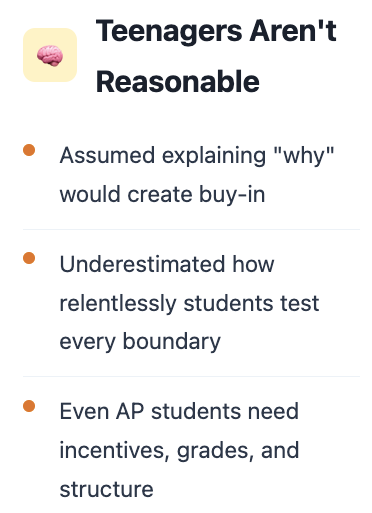
What I’ve learned is that the procedures and structures I associated with elementary school—tight routines, clear consequences, visible systems for behavior—are just as necessary in high school. Maybe more necessary, because the stakes of losing a classroom are higher and the recovery is harder. I needed a no button by my door. Students ask a billion things, and most of them deserve a no. That’s not being harsh; it’s being clear. And clarity, I’ve come to believe, is a form of care.
Grammar is missing
I knew I would be teaching reading and writing, but I didn’t realize how little grammar anyone knew—including myself. I’ve written about Judith Hochman’s sentence-level approach and about teachers like Brown who embed grammar instruction in content. What I didn’t fully appreciate until I was back in the classroom was how foundational this gap really is. My students don’t know what subjects and verbs are. They don’t understand phrases and clauses. They can’t identify the core of a sentence, which means they can’t manipulate sentences, which means they can’t write with control or read with precision.

This isn’t their fault. It’s a systemic failure that I’m now living inside. We stopped teaching grammar explicitly decades ago, for understandable reasons—the research suggested that isolated grammar instruction didn’t transfer to writing. But we never replaced it with anything. We moved to workshop models and mentor texts and revision conferences, all of which assume a foundation that doesn’t exist. The result is that high school English teachers like me inherit students who have been writing for years without ever learning how sentences actually work.
I’ve started doing a sentence of the day at the start of class, and it’s working. It’s accessible—students can engage with a single sentence even when they’re not ready to engage with a full text. It’s cumulative—we return to the same concepts, building familiarity over time. And it’s connected to everything else we do, because sentences are the unit of meaning. This is the kind of coherence I can build in my own classroom, even when the larger system offers none. But I didn’t know how much I needed it until I was back in the room.
Dialogue is hard
I’ve written a lot this semester about the importance of dialogue—extended conversations, Socratic questioning, the kind of talk that builds academic language and deep thinking. I still believe all of that. But I underestimated how hard it is to actually do. Small group discussions don’t work without contained behavior. Whole-class dialogue doesn’t work without clear participation structures. The two-minute adjustment I wrote about—the teacher’s ability to sense what’s happening and pivot in real time—requires a level of classroom control that I didn’t have in September.
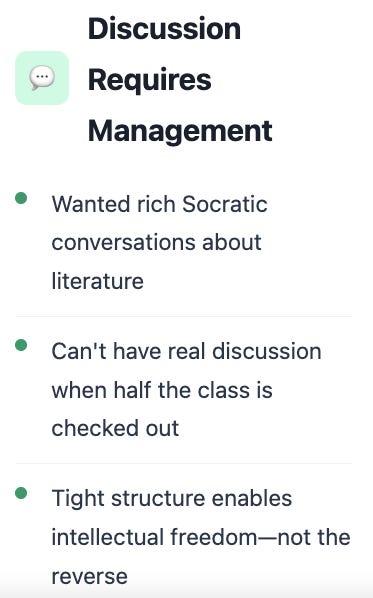
The problem isn’t that dialogue is overrated. The problem is that dialogue is downstream of management. You can’t have authentic intellectual exchange when students are on their phones, when side conversations are competing with the main discussion, when half the class has checked out because they don’t understand the text. I had to earn the right to do dialogue by first establishing routines, procedures, and expectations that made dialogue possible. I was trying to run before I could walk.
What I’ve learned is that the kind of teaching I want to do—conversational, inquiry-driven, responsive—requires a foundation of structure that I initially resisted. I thought tight management was the opposite of intellectual freedom. Now I understand that it’s the precondition for it. Students can take risks in discussion when they feel safe, and they feel safe when the environment is predictable and the teacher is in control. This is a paradox I’m still learning to manage.
What is English class even for?
The deepest incoherence I’ve encountered this semester isn’t about PD or evaluation—it’s about the fundamental question of what high school English is supposed to be. We say we teach “standards,” but I don’t think that’s true. We teach texts. But we exist in a system where texts have been increasingly disenfranchised—where the curriculum is built around skills and strategies that float free from any particular content. I’m supposed to teach Gatsby and Warmth of Other Suns, but I’m not really teaching the Roaring Twenties or African American history. I’m told to prepare students for the ACT English section, but also told the ACT isn’t the core of the course. Then what is the core?
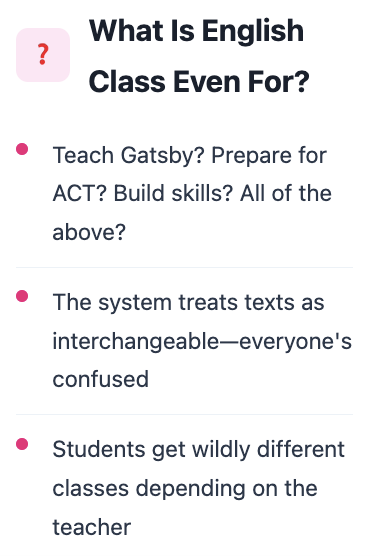
This incoherence isn’t just frustrating for me—it’s confusing for students. They move through their day experiencing completely different versions of English class depending on which teacher they have. Different expectations for what counts as evidence, how to structure an argument, whether grammar matters, what “close reading” means. The system sends contradictory messages, and students absorb the confusion. Meanwhile, teachers are overburdened with too many preps, too many students, too little planning time, and supports that feel adjacent to our actual challenges.
I don’t have a solution to this. But I’ve come to believe that naming the incoherence is the first step. We can’t fix what we won’t acknowledge. And at the classroom level, I can create coherence even when the system doesn’t provide it: consistent routines, clear expectations, cumulative skill-building, texts that matter and that I actually teach rather than just assign. That’s the work I can do. The larger systemic work requires collective action that I can advocate for but can’t accomplish alone.
Implications for practice
For teachers returning to the classroom after time away, my advice is simple: assume nothing. The students in front of you are not the students you remember, and you are not the teacher you were. Start with management, not instruction. Invest heavily in the first fifteen minutes of class, in seating charts, in procedures that feel almost elementary. Use grades as motivation—not punitively, but clearly. Students respond to incentives, and pretending otherwise doesn’t make you a more enlightened teacher; it makes you less effective. Say no more than you say yes. Students will test every boundary, and holding the line is how you build the safety that makes real learning possible.
For instructional leaders, the lesson is about coherence. Teachers need support that connects to their actual practice, not PD on strategies they won’t use or evaluation criteria focused on compliance. When you ask teachers to prioritize knowledge-building and challenging texts, make sure your curriculum, assessments, and professional development reinforce that priority rather than fragmenting it. And recognize that the grammar gap is real. High school teachers are inheriting students who lack foundational sentence-level knowledge, and we need systematic support to address it—not another workshop on discussion protocols.
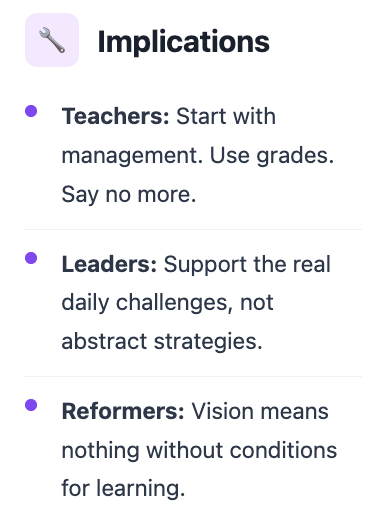
For researchers and reformers, I’d offer a reminder that classroom reality is different from policy vision. The ideas that seem clear from above become complicated on the ground. Chronological literature instruction sounds elegant until you’re managing thirty teenagers who don’t know what a clause is and are testing whether they can have their phones out. The gap between vision and implementation isn’t a failure of teacher will; it’s a function of the thousand small problems that consume classroom time and energy. Any reform that doesn’t account for those problems—that assumes teachers can simply execute a curriculum without first establishing the conditions for learning—will fail. I know, because I came back to the classroom with exactly that assumption, and I was wrong.
References
Hochman, J. C., & Wexler, N. (2017). The writing revolution: A guide to advancing thinking through writing in all subjects and grades. Jossey-Bass.
Kennedy, M. M. (2005). Inside teaching: How classroom life undermines reform. Harvard University Press.
Rod, I really appreciate your candor and reflectiveness in this piece. So good, and so real, and it makes me think about why sometimes what I hear from people removed from the classroom about teaching is hard to reconcile with realities. Still, it is the students that make my best experiences happen, and I'm sure you're finding the same. I would love to connect again soon for a conversation . . . and maybe you'll be at NCTE in 2026? Would be great to catch up in person too!
Oh, I love all this SO MUCH. Even though I've been in the classroom for 20 years, I was nodding along. Great curriculum means nothing unless a teacher can implement it, which is so freaking hard.