
Stop saying 'cognitive offloading'
The term 'cognitive offloading' medicalizes tool use, skips evidence, and obscures real questions about when AI supports or subverts learning.

Every few years, education gets a new crisis term that sounds scientific enough to demand attention. “Cognitive offloading” is having its moment right now, particularly in discussions about AI and student learning. The term suggests something profound is happening to our students’ minds—that by using ChatGPT to summarize readings or check their work, they’re somehow outsourcing essential brain functions and watching their cognitive muscles atrophy.

But here’s the thing: cognitive offloading isn’t a discovery. It’s a rebranding. The technical definition—using external resources to reduce mental effort—describes what humans have done since before we invented writing. You cognitively offload every time you set a reminder, use a calculator, or write a grocery list. We used to call this “using tools.” Now, when students do it with AI, we’ve medicalized it into something that sounds vaguely pathological.
This isn’t just semantic nitpicking. The term “cognitive offloading” is doing rhetorical work in education debates, smuggling in assumptions about what counts as legitimate learning and what represents dangerous shortcuts. It’s time we called out this terminology for what it is: a way to make our anxieties about new technology sound like scientific concerns about student cognition.
Selective panic problem
Notice how selectively we apply this concern. No one wrings their hands about cognitive offloading when students use spell-check, consult the periodic table during chemistry, reference formula sheets in physics, or use graphing calculators in calculus. We’ve accepted these as legitimate tools that free up cognitive resources for higher-order thinking. In fact, we often require students to use them, recognizing that memorizing every formula or calculation method isn’t the point of modern education.
The offloading conversation only emerges when we’re uncomfortable with the tool. Twenty years ago, it was Wikipedia and Google. Teachers worried students would stop memorizing facts. Thirty years ago, it was calculators destroying arithmetic skills. Fifty years ago, it was ballpoint pens ruining penmanship. Each generation’s new tool becomes the next generation’s basic equipment—but not before a period of panic dressed up in whatever scientific language sounds most credible at the time.
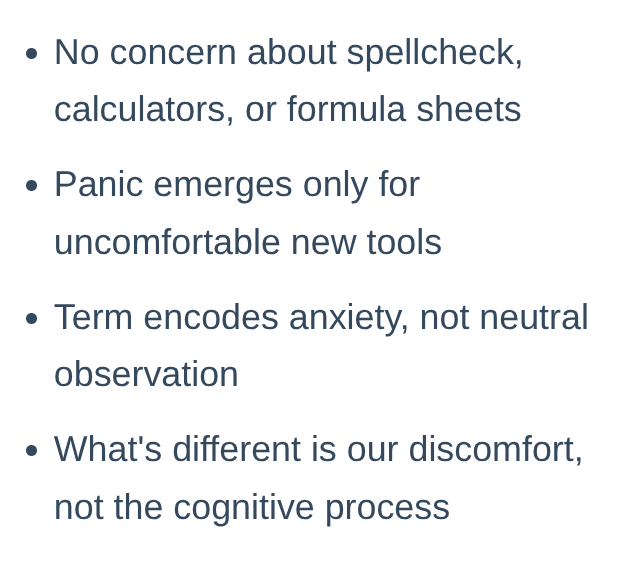
What makes AI different isn’t the cognitive process—students are still using external tools to reduce mental effort. What’s different is the scope of what the tool can do, and more importantly, our discomfort with that scope. When we label AI use as “cognitive offloading,” we’re not describing a neutral phenomenon. We’re encoding our anxiety about which cognitive functions we think should remain internal, based largely on what we had to do when we were students, not on any clear evidence about what builds lasting understanding.
Evidence doesn’t support the panic
The research on cognitive offloading with AI is remarkably thin for how confidently the term gets deployed. We have a handful of short-term studies with small samples, some correlational data that can’t establish causation, and one frequently-cited study showing AI helps struggling readers but might reduce engagement for strong readers. That’s not nothing, but it’s also not the clear empirical foundation you’d want before declaring a cognitive crisis.
More problematically, the existing research doesn’t actually demonstrate that AI-assisted learning differs meaningfully from other forms of academic support. When a student uses ChatGPT to understand a difficult text, how is this categorically different from using CliffsNotes, joining a study group, or asking a tutor for help? The cognitive process—getting external support to comprehend material—remains the same. The efficiency changes, but efficiency isn’t inherently problematic unless we’ve decided struggle itself is virtuous.
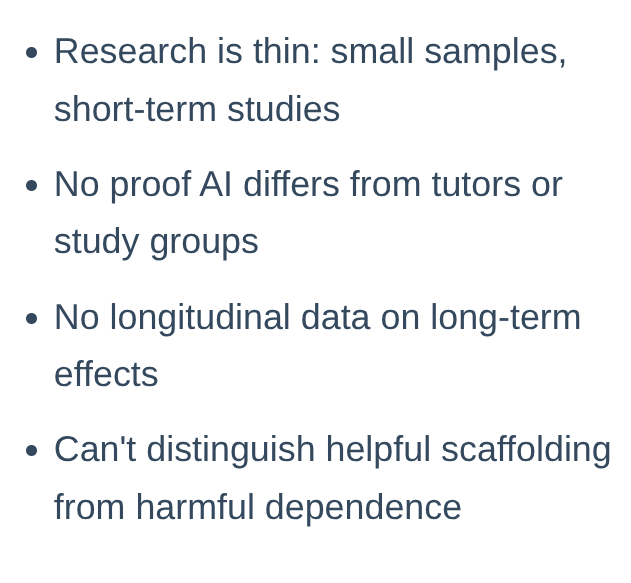
The longitudinal evidence we’d need to support strong claims about cognitive offloading simply doesn’t exist yet. We don’t know if students who use AI throughout their education develop different cognitive capacities than those who don’t. We don’t know if early AI use affects later independent reading ability. We don’t know if there are threshold effects where some AI use supports learning while excessive use replaces it. These are empirical questions that require years of careful study, not foregone conclusions we can reach through theoretical reasoning about working memory and cognitive load.
Reframing tool use in learning
Instead of asking whether students are cognitively offloading, we should ask more specific questions about tool use and learning goals. When does AI use support the development of disciplinary thinking, and when does it bypass important practice? This isn’t a question with a universal answer—it depends on the learner, the task, and the learning objective. A student who genuinely can’t access a text due to vocabulary gaps might need AI summaries as scaffolding. A student who could engage with the text but chooses not to might be missing valuable practice. The tool use looks identical, but the learning implications differ completely.
The challenge isn’t preventing cognitive offloading—it’s designing instruction that builds essential capacities while acknowledging that students have access to powerful tools. This might mean creating assignments where AI use is explicitly part of the process: having students fact-check AI summaries, compare AI interpretations with their own, or use AI as a first draft that they must substantially revise. It might mean being clearer about when we want students to work without tools and why that practice matters for their development.
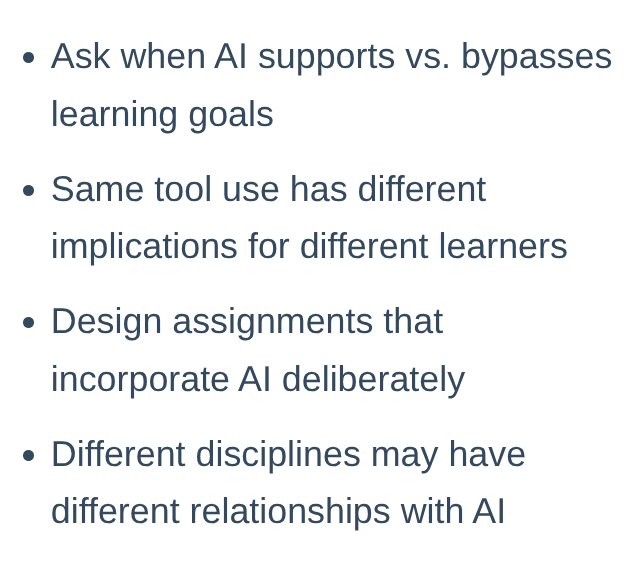
We also need to recognize that different disciplines and different skills might have different relationships with AI assistance. Literary analysis might require direct engagement with primary texts in ways that statistical analysis doesn’t require mental calculation. Writing might benefit from AI feedback in ways that mathematical reasoning doesn’t. These distinctions matter, but they’re obscured when we reduce everything to a binary of cognitive offloading versus authentic thinking.
Implications for practice
For teachers and instructional leaders, the first step is to stop using “cognitive offloading” as a conversation-stopper. When someone raises concerns about students using AI, probe deeper: What specific capacity are we worried about? Is there evidence this tool use prevents its development? Would banning the tool improve outcomes or just make tasks inaccessible for struggling students? These questions don’t have easy answers, but they’re more productive than broadly pathologizing tool use.
Schools and districts should resist the urge to create blanket policies about AI based on cognitive offloading concerns. Instead, support teachers in experimenting with when and how AI use supports or undermines specific learning goals. Create spaces for educators to share what they’re learning about effective AI integration. Some teachers might find AI summaries help struggling readers participate in discussions they’d otherwise be locked out of. Others might discover that AI feedback improves revision processes. Still others might identify specific practices where AI use clearly undermines skill development. This local knowledge is more valuable than top-down mandates based on theoretical concerns.
Finally, let’s have some humility about how little we actually know. The students in our classrooms today are the first generation learning alongside large language models. We’re all making educated guesses about what this means for their cognitive development, but they’re still guesses. Rather than speaking with false certainty about cognitive offloading and its dangers, we should approach this as action research: trying things, observing carefully, adjusting based on evidence, and remaining open to the possibility that our initial assumptions might be wrong. The term “cognitive offloading” suggests we already know what’s happening and why it’s concerning. The reality is we’re just beginning to understand how these tools change learning, and pretending otherwise helps no one.
While I support a lot of the points you raise within this piece—the nuance we need in considering how AI is implemented in different contents and practices; the ubiquity of "cognitive offloading" across many non-AI practices, too, etc.—I was a bit curious about this piece overall, given your other writings.
Much of your emphasis with The Science of Dialogue establishes a pretty clear standard for teachers: our practices need to be driven by data and research, and you've articulated the case for this frequently. (And convincingly, and posts like yours on "providing claims" have been really helpful in my own reflections!)
Yet here, it feels like you reverse that standard: you seem to argue that objections to use of AI in teacher practices are thin on evidence/research—an impossible barrier to overcome, I'd add, given how new this is!—and almost seem to scapegoat what to me feels like honest critiques by calling it "medicalizing tool use." Couldn't the same be said to much of the language around Science of Learning discourse?
I bring this up because right now this feels like the double-standard I'm recognizing in broader education discourse: an insistence upon evidence-based and research-driven practices EXCEPT for with AI, where it is incumbent upon us to experiment/explore without being held back by worries about proof of effectiveness, potential downsides, etc.
Just trying to square these two points across your writings! And I continue to appreciate the way you push my thinking as a teacher—so please know that this comes from genuine curiosity and appreciation around exchange of ideas.