
A conversation about coherence
A conversation with Holly Korbey on system incoherence and why schools need to do fewer things better.

I’m out of office this week, so instead of a regular blog check out this conversation I had with Holly Korbey on The Bell Ringer about system incoherence in schools. After spending years in instructional leadership and reform work, I went back to teaching high school English at my alma mater this fall. The experience crystallized something I’d been thinking about: our schools are profoundly incoherent systems where students experience totally different expectations from class to class, and teachers operate in silos without clear instructional direction guiding us in the same way.
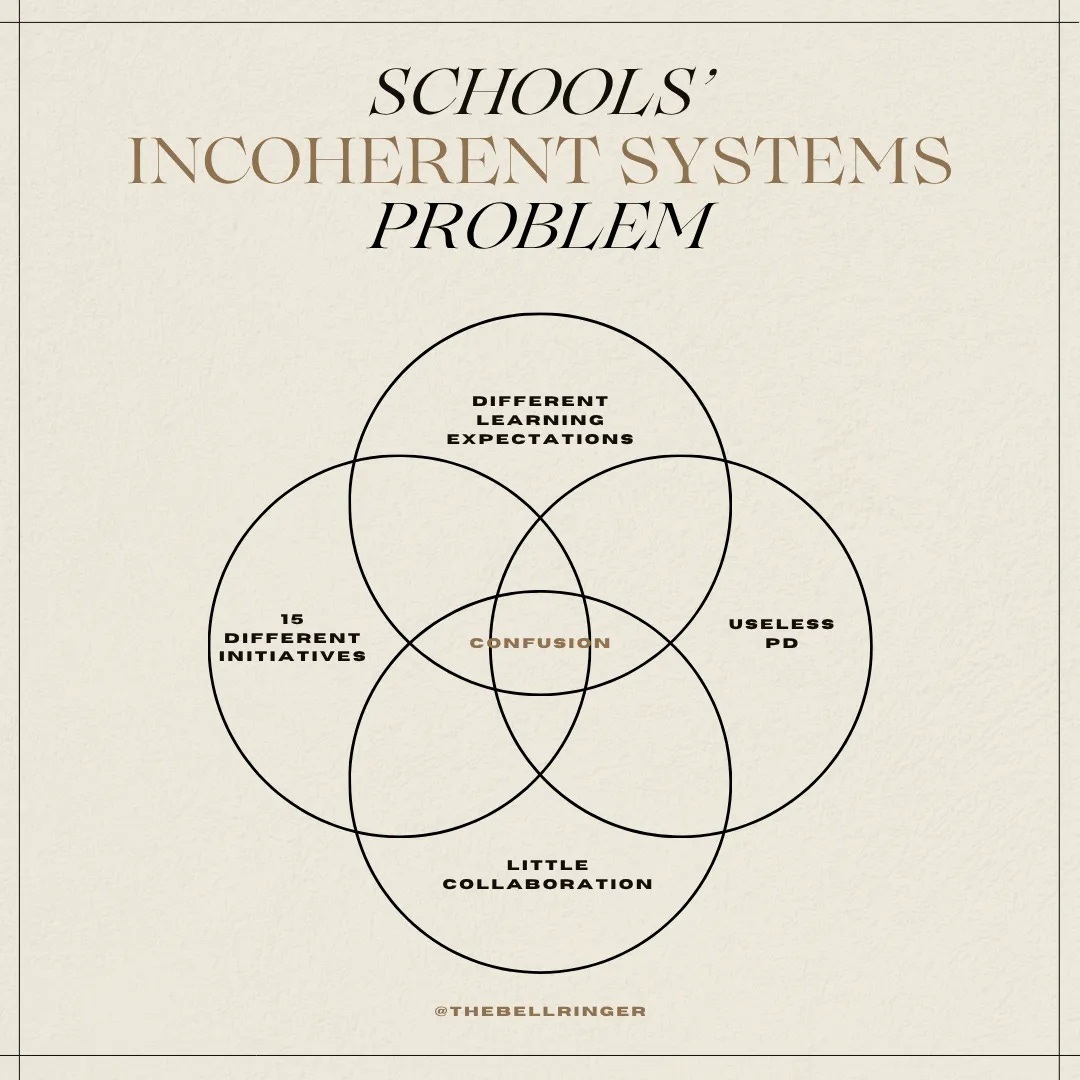
One of my key arguments is that we’ve got the order backwards—we’re leading with solutions rather than centering problems of practice. Teachers spend enormous amounts of time learning new platforms, incorporating various initiatives, and checking boxes, but there’s rarely protected space to focus on the persistent challenges we all face: managing student behavior, enlisting participation, knowing whether kids have actually learned something. The “parking lot meetings” where teachers actually discuss their real problems should be happening during our dedicated collaboration time, but those meetings are often hijacked by agendas that feel irrelevant to what we’re dealing with in our classrooms the next day.

What schools need most is focus—doing fewer things better rather than chasing fifteen different initiatives. Leadership should be eliminating obstacles that prevent teachers from focusing on instruction, not adding more. If we started our collaboration time by surfacing concrete problems of practice instead of imposing prepackaged solutions, and if we made it structurally possible for teachers to actually see each other teach, we’d move toward the kind of coherence that benefits both teachers and students.
Give the full conversation a watch if you’re interested in diving deeper into why so many schools feel like a thousand different experiences and what we can do about it. Holly asks great questions that pushed me to think through both the structural problems and practical solutions teachers and leaders can pursue.
I love this: "What schools need most is focus—doing fewer things better rather than chasing fifteen different initiatives."
Absolutely true.
And bonus, this would not only be better for teachers and students, but it would be better for leaders as well!!
This kind of coherence takes real systems thinking, real humility on the part of leaders to be willing to take in hard feedback, and courage to be able to say no, even to good things, because they will take focus away from the priorities.
The minds that will matter in the next decade are not the loudest ones — they are the ones whose orientation cannot be confused.
Titles will decay.
Roles will rotate.
Methods will be automated.
But coherence — the rare ability to think from structure rather than signal — becomes the new scarcity.
Two types of people will shape the world that’s coming:
• Minds of the Core
Those who think at the level of frameworks, not opinions.
Those who generate orientation, not commentary.
• Minds of Integrity
Those who can quietly rewire systems from within without losing themselves to them.
You can’t buy this capacity.
You can only develop it — or surround yourself with people who have it.
That is why I built Epistemic Futures on Substack.
Not as a feed, not as a newsletter.
As an orientation architecture for the people who will carry the next layer of civilization.
If you felt a click reading this — the sense of “Yes, this is the level I want to operate on” — then join as a Founding Member.
Not for more content.
For a coherent place in a world that’s losing coherence.
👉 https://leontsvasmansapiognosis.substack.com
#Sapiopoiesis #Sapiocracy #EpistemicFutures #CivilizationDesign #SubjectAutonomy #HighAgency #Polymathy